The Economist put out a good article on medical tourism:
http://www.economist.com/business/displayStory.cfm?source=hptextfeature&story_id=11919622Over the past few years, increasing attention has been directed at the millions of American's without health insurance. With all the political debates over the years, we have still to come up with a feasible solution for our country's 47 some million "medical refugees." Yet, in a somewhat unexpected way, one answer seems to arise from outside of our country's own borders – the notion of high-quality hospitals in other countries providing cheaper care. Medical tourism.
This whole phenomenon of medical tourism is fascinating to me as a student who has been told several times that healthcare delivery in the United States is local, and limited to the borders of our own country. Global health has traditionally been associated primarily with epidemiology; whereas, the business of hospitals remains the business of the local. But alas, the globalization of healthcare delivery; here is a situation that must be taken seriously. May Clinic and Hopkins are leading the way with branches in Singapore and the UAE. Grameen bank is partnering with a Japanese hospital system to deliver services to its members. Bumrangrad hospital in Thailand already sees thousands of American patients a year. Deloitte estimates that medical tourism will become a $21 billion a year to developing countries in less than 5 years.
Here's an example. Imagine Harold has to pay $60,000 for a spine surgical procedure at his local hospital down the street. Later in the week he sees an online add from a hospital in Thailand that is offering the same surgical procedure plus a luxurious week on a splendid Thai beach, with top quality service and free food, for a mere $30,000. Sounds good, but it's a hospital in Thailand, how good can it be? But then, he later finds out that the hospital is Joint Commission accredited (the highest accreditation that an American hospital can receive), and in fact, the surgeons in the Thailand hospital seem more renowned than his own hospital's. All of a sudden that deal looks pretty good.
Medical tourism is exciting in that, just like every other industry from auto to pharmaceuticals, healthcare delivery is catching the travel bug – its going global too! But, this is not enough. Yes, medical tourism is benefiting the middle-class, and yes medical tourism may lead to more competition, which may lead to better quality service amongst hospitals everywhere in the world. But, what about the implications for the poorest of the poor? Nevermind the profits that medical tourism can bring to a joint-accredited international hospital in Thailand. Another question we have to ask is, are these hospitals still serving their own people? Are these medical tourist programs simply bringing in profits for shareholders, or are they subsidizing community benefit programs for the local people, who most need services?
Overall medical tourism appears to be a good thing. But it still has a ways to go. First the US needs to start realizing that hospitals are going global - let's go with the flow and stop resisting. Second, and maybe more importantly, let's not forget about those who most need services. It would certainly be a shame if the American middle-class medical refugees brings about a new group of medical refugees - those in the very country that houses the hospitals.
-Derrick Pfeffer
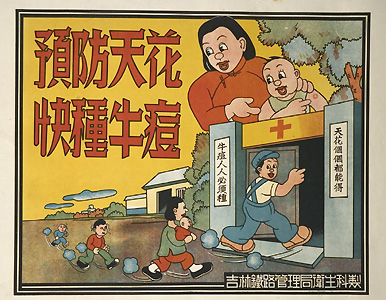 "Go to have smallpox vaccination, ca. 1956."
 " How baby hookworms get into human bodies (1), 1957."
 "Properly cover yourself with bedding during sleep, ca. 1935."

